The AI sector is not in a bubble market, but the prices of some individual AI companies behave with the price variability and exuberance characteristic of a bubble, according to new Cornell research.
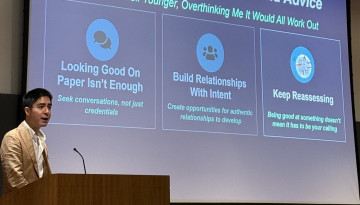
Jason Marvin, Ph.D. ’22, spoke about his journey from biomedical engineering doctorate to his current position during the Summer Success Symposium alumni keynote on Aug. 18.
Researchers developed a method that uses krypton gas to slash the deposition temperature of the corrosion-resistant metal tantalum, resulting in thin films that have substantially higher electronic conductivity.
Researchers developed an ultrafast-dissolving nanofiber film that can deliver a cocktail of three drugs so quickly and effectively, 90% of the formulation is released in less than two seconds.
A genetically engineered bacterium can rapidly break down one of Earth’s most abundant minerals, opening a promising new pathway for removing CO2 from the atmosphere and recovering critical elements, according to new Cornell research.
Using a photochemically driven labeling technique, a Cornell-led research group has devised a way to capture cancer-specific protein-to-protein interactions, which could spawn targeted therapies for prostate and other forms of the disease.