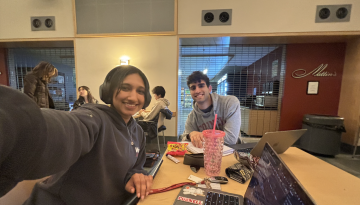
Nour Gajial ’26, left, and Yanni Kouloumbis ’26, founded MathGPT to help high school and college students struggling with math understand how to approach their problems step by step.
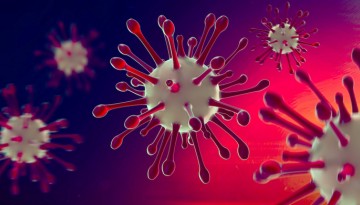
Cornell researchers have developed a bioelectric device that can detect and classify new variants of coronavirus, and potentially other viruses, such as measles and influenza, to identify those that are most harmful.
The program’s goal is to “produce a diverse body of broadly educated fellows” in areas targeted by DOE’s Office of Science, including RF superconducting structures, high brightness electron sources for linear accelerators, physics of large accelerators and system engineering, and operation of large-scale accelerator systems.
Cornell researchers have tested an ecological tool in the fight to control weeds in silage soybean and corn fields: adding carbon to soil in the form of sawdust and rye hay.
Workers and socially marginalized people in both countries should pressure leaders not to ratchet up rhetoric and to center solidarity across borders, ILR's Eli Friedman argues in a new book.
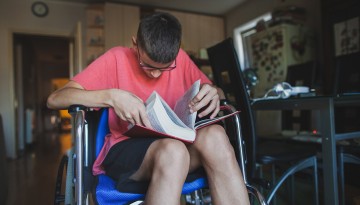
ACT for Youth, which promotes adolescent health and well-being in New York state, has been awarded $5 million to help local health departments improve care for youth with special needs.
A new study has found that in 60 middle- and low-income countries, husbands are far more likely to want more sons, while wives are more likely to want more daughters, an equal numbers of boys and girls or have no preference.
Cornell inventors are turning visionary ideas into tangible solutions to global challenges. Cornell’s Center for Technology Licensing celebrated their achievements at its inaugural Bearers of Innovation event.