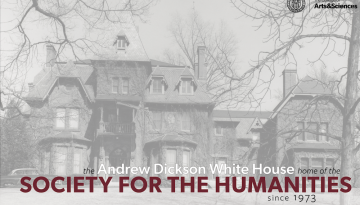
To honor the anniversary, the Society has produced a booklet chronicling the history of the A.D. White House as president’s home, art museum and locus for the humanities at Cornell.
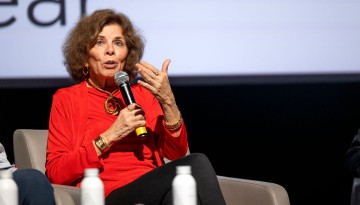
Former ACLU president Nadine Strossen discussed First Amendment issues with Provost Michael I. Kotlikoff and a panel of student leaders on April 29 in Willard Straight Hall.
The collection “Households in Context: Dwelling in Ptolemaic and Roman Egypt” shifts the archaeological perspective from public and elite spaces such as temples, tombs and palaces to everyday dwellings and interactions of families.
Contract negotiations have begun between Cornell and the union that represents graduate teaching assistants, graduate research assistants, research assistants and graduate assistants at the Ithaca, Geneva and Cornell Tech campuses.
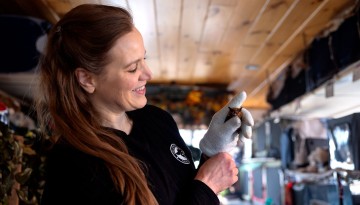
Cornell Lab of Ornithology staff member Victoria Campbell spends her free time caring for bats in need – setting tiny broken bones, feeding babies, treating illness and nursing native bats back to health so they can be released.
A Cornell-led research team derived the age of Selam, a “moonlet” orbiting the asteroid Dinkinesh in the main asteroid belt, based only on the pair’s dynamics.
Dozens of stakeholders responsible for the new building for the Cornell Ann S. Bowers College of Computing and Information Science penned their names onto a 20-foot steel beam that will soon buttress the building’s fourth floor.
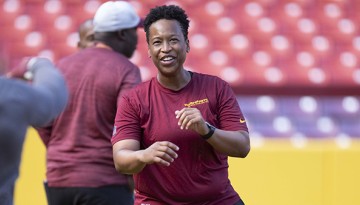
In 2021, Jennifer King became the first black woman to earn a full-time position on an NFL coaching staff. On May 3 she will be the featured speaker at an event in Newman Arena.
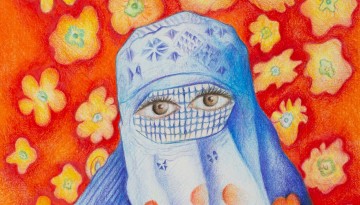
Afghan visual artist Elja Sharifi, currently a visiting scholar at the Herbert F. Johnson Museum of Art, sees her escape from the Taliban as a call to action. She will enter Cornell’s PhD program in art history next fall.