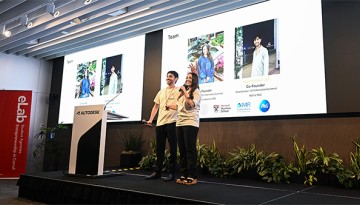
Collaboration was the theme of the evening at the second annual Community Engagement Awards, held April 16 and hosted by the Einhorn Center for Community Engagement to celebrate excellence in local and global university-community partnerships.
A team of mostly first-year students created Brewing CommuniTea, an Earl Grey tea ice cream with caramel swirls and buttery shortbread pieces inspired by Cornell’s theme year.
Cornell researchers and administrators joined industry and government partners to celebrate the opening of new animal respiration stalls in the Department of Animal Science.
Pietro (Piero) Pucci, an influential classical scholar who spent more than 50 years in the Department of Classics in the College of Arts and Sciences, died in Paris on April 7. He was 96.
Led by College of Architecture, Art and Planning experts, “Embodying Justice in the Built Environment: Circularity in Practice” seeks to help communities center justice principles while implementing sustainability strategies.
Being asked to provide demographic information in official forms such as job applications – but finding one’s own identity group missing from demographic options provided – can signal a low likelihood of belonging in a given setting and trigger anger, according to new Cornell research.