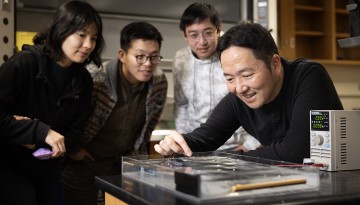
Inspired by a small and slow snail, scientists have developed a robot protype that may one day scoop up microplastics from the surfaces of oceans, seas and lakes.
“Startup Launch – Liftoff with Legal 101 for Entrepreneurs,” was created by Zach Shulman and a team of corporate and intellectual property lawyers at WilmerHale,
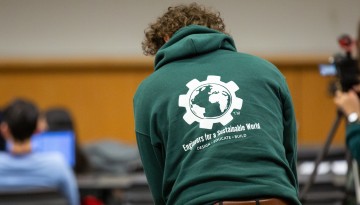
With the goal of exploring new solutions for environmental challenges, 150 students from across the continent convened Nov. 9-12 at Cornell for the 2023 Engineers for a Sustainable World Conference.
The 2030 Project has launched a new Climate Solutions Fund and announced 15 new Research-to-Impact Fast Grants, financed in part by Dead & Co. concert proceeds.
The Cornell Center for Social Sciences has awarded 16 grants across eight Cornell schools and colleges this fall, seeding research in 12 different departments that tackles some of society's most immediate challenges.
Professor Jessica Chen Weiss, an expert on U.S.-China relations, was among the attendees of the dinner following President Joe Biden and Chinese President Xi Jinping’s historic summit on Nov. 15 in San Francisco.
Researchers have demonstrated the use of artificial-intelligence-selected natural images and AI-generated synthetic images as neuroscientific tools for probing the visual processing areas of the brain.