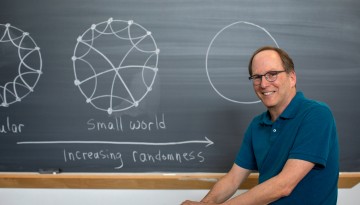
In 1998, Professor Steven Strogatz and then-student Duncan Watts, Ph.D. '97, published a model that launched the field of network science – the results of which are ubiquitous in today’s world.
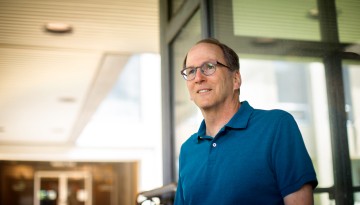
Bolstering its commitment to broader engagement, the College of Arts and Sciences has established the Winokur Professorship in the Public Understanding of Science and Mathematics with mathematician Steven Strogatz as the inaugural holder of the chair.
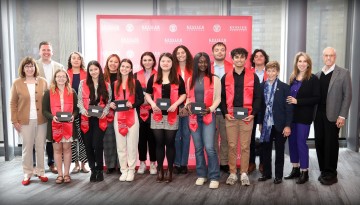
Nineteen faculty and professional staff members in Cornell’s four state contract colleges have been selected for the 2022-23 State University of New York Chancellor’s Awards for Excellence.
Venturing out of one’s comfort zone to perform a task – and then performing poorly in that task, such as a baseball pitcher trying to hit – can lead to better performance when returning to one’s specialty, new research suggests.
Johnson received the inaugural Schwartz Research Fund Visionary Grant, worth $375,000, to support her research that will delve deeply into understanding how human milk nutrients contribute directly to infant gastrointestinal health.
A new study finds thathundreds of bacterial groups have evolved in the guts of primate species over millions of years, but humans have lost close to half of these symbiotic bacteria.