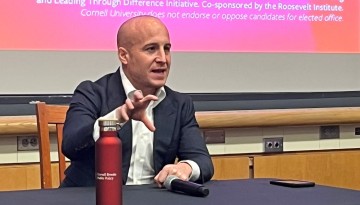
Max Rose, a former U.S. representative, was joined by former representative Fred Upton at a Jeb E. Brooks School of Public Policy event focusing on strategies for restoring civil discourse in the face of performative politics. Rose, a Democrat, and Upton, a Republican, said Congress has actually been relatively productive despite the degree of political polarization.
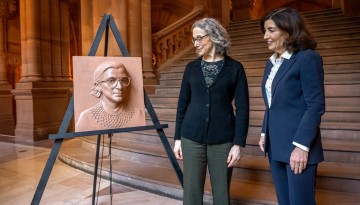
For the first time in 125 years, the face of a celebrated New Yorker – Ruth Bader Ginsburg – will be permanently commemorated at the New York State Capitol’s Great Western Staircase.
College students – who have the time and energy to serve as well as the desire to learn – are well positioned to advance their education while helping communities prepare for potential disasters, according to a new book co-edited by a Cornell researcher.
Employing AI to write full messages in an arena where personal correspondence is crucial – representative government – appears to be more effective than using AI to generate individual sentences, according to new Cornell research.
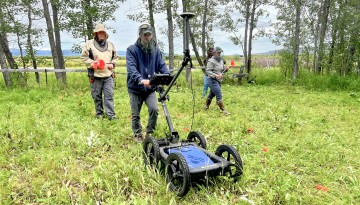
A Cornell research scientist used ground-penetrating radar and AI modeling to locate the communal graves of approximately 93 victims of the Spanish influenza at Pilgrim Hot Springs in Alaska.
While creating quality craft beers, serving up a pleasant tasting-room experience with friendly, informed servers can bring more profit to a brewery, according to new Cornell research.
Fish can adjust their sensitivity to the actions of others – such as fleeing due to a false alarm – in order to reduce the risk of responding to misinformation, according to a new study.
Beginning in June 2023, graduate students funded by assistantships will be eligible to purchase the same permits as faculty and staff, offering new options for students who carry out research and teaching on campus.
From realtime visualization in video games to realtime urban monitoring, advances in computer, communication, and media technologies offer exciting new possibilities while raising urgent questions for architecture, planning, and digital studies. The second Preston Thomas Memorial Symposium at Cornell AAP this spring invites artists, designers, and scholars to explore them.