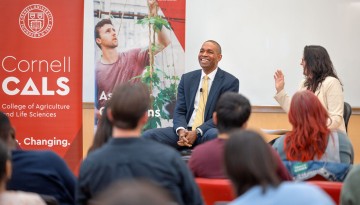
New York Lt. Gov. Antonio Delgado engaged with students and faculty on topics ranging from biological engineering to nutrition to 4-H programs during his first tour of the Ithaca campus on Feb. 2.
A new study finds that nest boxes of commercial eastern common bumblebees (Bombus impatiens) lead to the deaths of wild queens who are attracted to the brightly colored hives.
Enzo Traverso critiques a new trend in historical writing, in which historians place themselves in their books, framing their accounts of history as first-person investigations and revealing emotional ties to their subjects.
Ten exceptional early-career scholars will join the College of Arts and Sciences this year as recipients of Klarman Postdoctoral Fellowships, enabling them to pursue leading-edge research in the sciences, social sciences and humanities.
A new center at Cornell will fight the rise of antibiotic resistance, a global health challenge that threatens to reverse critical advances in modern medicine.
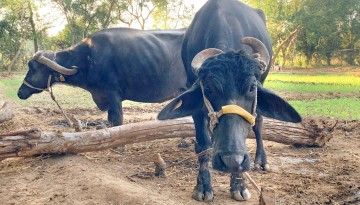
Cornell will teach small farmers in India – the world’s largest dairy producer – how to produce milk more efficiently while limiting greenhouse gas emissions.
A new computer model using machine learning to predict migratory bird movement could open the door to new insights on migration timing, stopover sites, bird response to climate change, light pollution and more.