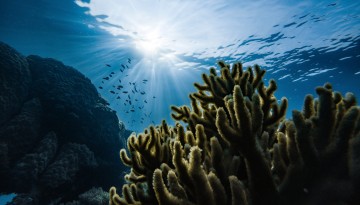
Attracting more than 1,000 students every fall, Intro to Oceanography is the largest course at Cornell. When Senior Lecturer Bruce Monger started recording the lectures for remote teaching, he partnered with eCornell and ended up developing a publicly accessible oceanography and climate sustainability course too.
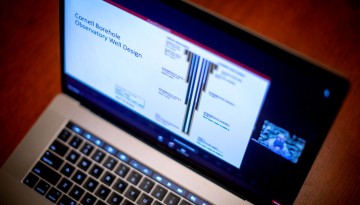
Cornell is moving forward, and underground, with plans to drill an observatory borehole to explore the viability – and ensure the safety – of using geothermal energy to heat the Ithaca campus.
Archivists, curators and librarians are finding virtual ways to help faculty members teach, using gems from Cornell University Library’s rare collections, from medieval texts on parchment to punk show flyers.
A streamlined process for awarding green cards to international STEM doctoral students graduating from U.S. universities could benefit American innovation and competitiveness, according to new research.
Far below the gaseous atmospheric shroud on Saturn’s largest moon, Titan, lies Kraken Mare, a sea of liquid methane, which astronomers have estimated to be at least 1,000 feet deep.
The annual Cornell Day of Data, this year a two-day virtual event, Jan. 27-28, brings together professors, researchers and students from across the university to share techniques, tools and insights in working with data.
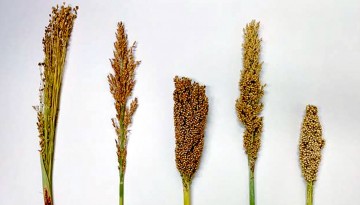
A new study found that harmful mutations in sorghum landraces – early domesticated crops – decreased compared to their wild relatives through the course of domestication and breeding.
New research reveals how proteins, called “pioneer transcription factors,” help turn on key genes that give cell types their unique properties and functions.
A Cornell collaboration has found a way to grow a single crystalline layer of alpha-aluminum gallium oxide that has the widest energy bandgap to date – a discovery that clears the way for new semiconductors that will handle higher voltages, higher power densities and higher frequencies than previously seen.