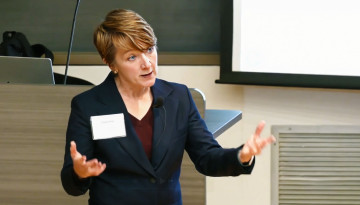
Thomas A. Lewis named Graduate School dean, vice provost

The Cornell Board of Trustees Executive Committee voted on June 2 to approve the five-year appointment, effective Aug. 1.

Biodiversity allows for sustainable fisheries, better nutrition

To satisfy the seafood needs of billions of people, offering them access to a more biodiverse array of fish creates opportunities to mix-and-match species to obtain better nutrition from smaller portions of fish.

Savely Senderovich, scholar of Russian literature, dies at 89

Savely Senderovich, professor of Russian literature and medieval studies emeritus in the College of Arts and Sciences for more than 30 years, died on April 1 in Clarkstown, New York. He was 89.

Kanvas Biosciences harnesses the power of the microbiome

Company was launched through the Center for Life Science Ventures with technology licensed through the Center for Technology Licensing.

Brooks Public Policy PhDs address policy, begin careers at top institutions

For the five graduates who have earned Ph.D.s in public policy from the Brooks School in 2025, their academic journeys included COVID disruptions and a transition from the Department of Policy Analysis and Management to Brooks.

Around Cornell

New ‘stewards’ of the Bowers legacy congratulated at recognition ceremonies

The Cornell Ann S. Bowers College of Computing and Information Science recognized the largest number of graduates in its history at three ceremonies held Commencement weekend.

Around Cornell

Canine genes offer clues to gastric cancer in humans

In a new study, a team of Cornell researchers used canine DNA to uncover more than 15 genes linked to gastric cancer.

US Rep. Beth Van Duyne ’95, Brooks School dean to discuss policy at Reunion

U.S. Representative Beth Van Duyne ’95, R-Texas, will join Colleen Barry, dean of the Jeb E. Brooks School of Public Policy, for a timely discussion that will explore the intersection of public policy, politics and civic engagement.

Linking pay to performance boosts AI use in decision-making

Contrary to highly cited research from more than 30 years ago, an incentivized pay structure will lead to greater reliance on AI in decision-making than flat, fixed compensation, according to a study co-led by a Cornell researcher.