The Cornell High Energy Synchrotron Source will partially restart operations in June to conduct research related to treatment of SARS-CoV-2, the virus that causes COVID-19.
With the switch to remote learning in April, students in the Community Learning and Service Partnership program had to find creative ways to modify their learning partnerships.
Amid the challenges of shifting to virtual learning, students and faculty found opportunities for innovation, connection and intellectual growth. Here are snapshots of six courses that took creative approaches to their online formats.
Sophomores in the Milstein Program in Technology and Humanity were supposed to spend the summer of 2020 at Cornell Tech, but due to the pandemic, that program has moved online.
Plant biologist Michael Scanlon received a $1.8 million grant from the National Science Foundation Plant Genome Research Program to continue his research on the process of shoot development in maize.
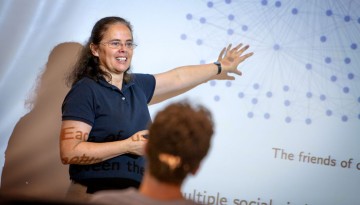
Éva Tardos, the Jacob Gould Schurman Professor of Computer Science, has been elected to the American Philosophical Society, the oldest learned society in the United States.
Historian Barry Strauss notes that plagues and epidemics have often been linked to wars. The current pandemic will highlight the fragility of society and significantly influence U.S. politics – with unknown consequences – and the U.S.-China relationship, he says.
Risk communicators must get trust, tradeoffs and preparedness right as the COVID-19 pandemic progresses, according to Cornell experts Dominic Balog-Way and Katherine McComas.
Rob Scott, director of Cornell Prison Education Program, has organized 14 New York colleges and universities to provide masks for every person incarcerated in the state – nearly 43,000 people.