Three collaborative New York City-based projects, designed to inspire cross-campus research partnerships, have been awarded grant funding totaling approximately $500,000 from the College of Agriculture and Life Sciences.
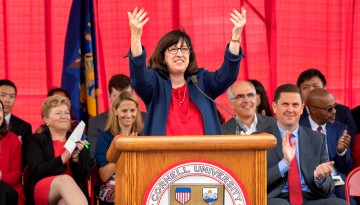
President Martha E. Pollack urged incoming students to keep their headphones off and their minds open to everything they might experience at Cornell during New Student Convocation, Aug. 24 at Schoellkopf Field.
Children – especially teens – growing up in disadvantaged neighborhoods face greater odds of unhealthy weight gain as adults, according to new research by a Cornell sociologist.
The ILR School’s Groat and Alpern award winners, Kathleen Weslock, M.S. ’83 and Barry Beck ’90, will be honored during a celebration event April 23, 2020, at the Pierre Hotel in New York.
Events at Cornell include a Glee Club and Chorus concert, free films for students, a sustainability scavenger hunt and exhibits highlighting the natural world.
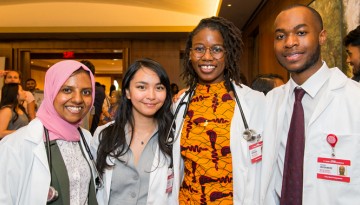
Weill Cornell Medicine’s 106-member Class of 2023 was sent off to medical school Aug. 20 with the annual White Coat Ceremony that officially marks the beginning of graduates’ medical education.
Geoffrey Coates is leading a team of Cornell researchers working on the next generation of environment-friendly plastics as part of the Center for Sustainable Polymers, which received a five-year, $20 million grant renewal from the NSF.