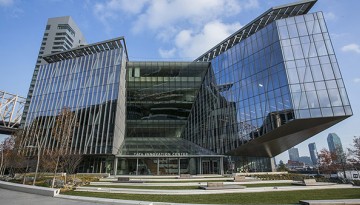
A $50 million investment from Tata Consultancy Services (TCS), a leading global IT services, consulting and business solutions organization, will advance Cornell Tech’s mission to create pioneering leaders and technologies for the digital age.
With a strong start incubating in Cornell’s entrepreneurial ecosystem, Empower Equity now offers a new kind of financing, so small- and medium-sized companies, schools and municipalities can use sustainable energy.
Cornell University held the first Annual Cornell Cancer Research Symposium at the College of Veterinary Medicine on April 5-6 to showcase the breadth of cancer research on the Ithaca campus.
Emeritus professor Jerrold Meinwald, who was awarded the National Medal of Science in 2014 by President Obama and is credited with co-founding the field of chemical ecology, died on April 23 at 91.
In “The Rise of the African Novel: Politics of Language, Identity and Ownership,” Mukoma Wa Ngugi addresses the critical reception of African literature and its beginnings.
More than 100 students who participated in three business competitions and a demonstration embodied the spirit of entrepreneurship at the annual Celebration conference April 18-20.
In our solar system, moons stay close to home planets. But beyond our cosmic neighborhood, lunar bodies around exoplanets can become castaways and carom across galaxies.