Cynthia Dwork, a computer scientist at Harvard University and pioneer of modern data privacy, will present three public lectures at Cornell May 5-7 as part of the University and Messenger Lecture Series.
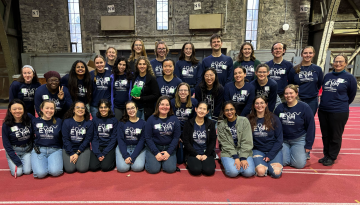
Over 300 graduate students came together to offer this year’s annual Expanding Your Horizons conference, putting in countless hours of volunteer work to host students for a day of hands-on learning experiences.
In collaboration with farmers, researchers found that emission intensities from New York state dairy farms were lower per gallon of milk than national estimates and among the lowest reported across continents.
A new study from Cornell on AI writing assistants finds these tools have the potential to function poorly for billions of users in the Global South by generating generic language that makes them sound more like Americans.
In the season finale of the Inclusive Excellence Podcast, co-hosts Erin Sember-Chase and Toral Patel welcome Kathryn Boor ‘80, dean of the Graduate School and vice provost for graduate education for a conversation about her journey at Cornell – both as a student and an academic leader.
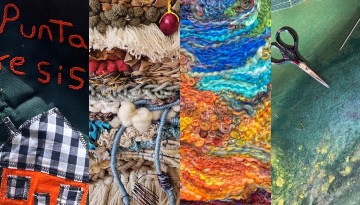
A collaboration between Cornell faculty, students and Ithaca community members is bringing together a monthlong event in downtown Ithaca, focused on Latine artists.
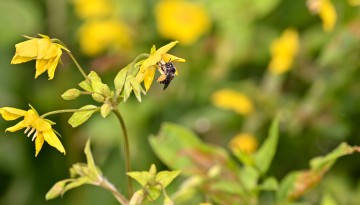
A new publicly available tool uses data from the Cornell Lab of Ornithology’s eBird program to track and estimate the diversity of wild bees across the eastern and central U.S. - with implications for conservation and agriculture.
Regional high school students engineered bath bombs, extracted DNA from fruit and learned about the college application process as part of the Women’s Outreach in Material, Energy, and Nanobiotechnology event hosted by the Chemical and Biomolecular Engineering Graduate Women’s Group.
The way DNA folds inside the nucleus of brain cells may hold the key to understanding a devastating form of brain cancer called glioblastoma, suggests a new preclinical study from Weill Cornell Medicine researchers.
Researchers found that at low levels of mercury, selenium additions did seem to help mayfly larva from accumulating mercury. But at high mercury levels – the condition in which environmental remediation is most needed – selenium actually made mercury accumulation worse.
Cornell Law School's Michelle Whelan provides the framework for business leaders to strengthen their written correspondence in the Legal Writing and Communication certificate program.