The Lab of Ornithology’s visitor center will close for 10 months beginning Aug. 1 for a multimillion-dollar redesign that will add new hands-on exhibits and visitor offerings.
Greeshma Gadikota, associate professor of engineering, has gathered a team to help capture carbon dioxide in the concrete-making process as they aim to create low-carbon construction materials from it.
In a new book, landscape architect Martin Hogue investigates the history and evolution of recreational camping through the lens of its most important and familiar components.
Filmmakers may soon be able to stabilize shaky video, change viewpoints and create freeze-frame, zoom and slow-motion effects – without shooting any new footage – thanks to an algorithm developed by researchers at Cornell University and Google Research.
Researchers have built a new, interpretable machine-learning framework that captures stock- and industry-specific information and predicts financial returns with greater accuracy than traditional models.
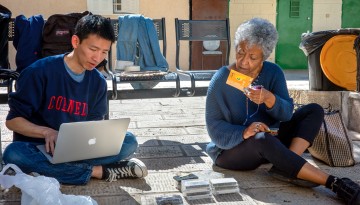
Thomas Feng, a doctoral student in performance practice, is identifying and cataloging the piano music of the late Emahoy Tsege-Mariam Gebru, a composer with a cult following.
Cornell Career Services, the central career services office at Cornell University, is the college winner of the 2023 National Association of Colleges and Employers Award for Technology Excellence for its Career Development Toolkit.
Unused solar, wind and hydroelectric power in the U.S. could support the exponential growth of transactions involving non-fungible tokens, Cornell Engineering researchers have found.
When researchers limited the memories of automatons competing in a wildlife poaching game, the computer took the same kinds of decision-making shortcuts as actual humans playing the game.
The Humphrey PACT Program promotes research collaboration between undergraduates and Hubert H. Humphrey Fellows, midcareer professionals specialized in agriculture, rural development and natural resource management, who spend one year at Cornell for professional development.
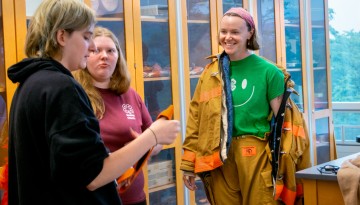
The annual 4-H Career Explorations Conference – where 4-H members attend courses designed by various Cornell units and experience living on a college campus – welcomed nearly 250 young people from across New York state to Cornell June 27-29.