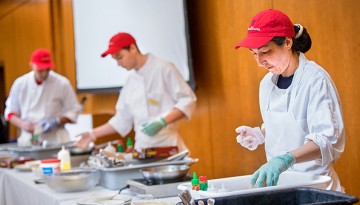
Cornell has entered into an agreement with Ithaca College this summer to help its South Hill neighbor rapidly transition to providing complete in-house dining operations to its students by the start of the fall semester.
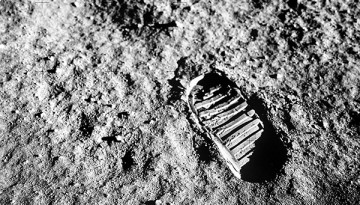
Cornell will celebrate the 50th anniversary of the Apollo 11 moon landing with a panel on exoplanetary discovery, a lecture by author Andrew Chaikin, music by the Aeolus Quartet and a display in Kroch Library.
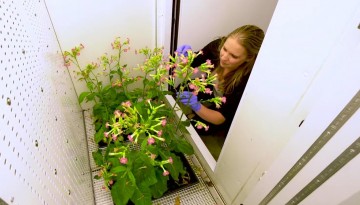
Cornell and University of Illinois researchers have engineered plants capable of making proteins not native to the plant itself, which opens the door for cheaply making proteins for industrial and medical uses.
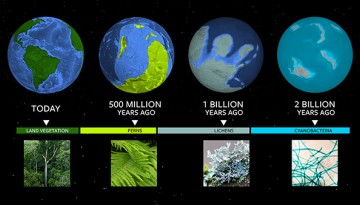
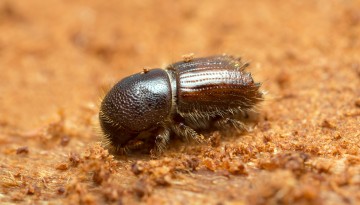
On July 11-12, 10 journalists will descend on The Białowieża Forest, where they are taking part in an audio storytelling workshop, to report on the role climate change is playing in the increasing infestations of bark beetles, a forest pest.
A breakthrough imaging technique developed by Cornell researchers shows promise in decontaminating water by yielding surprising and important information about catalyst particles that can’t be obtained any other way.
The White House has recognized Cornell faculty members – Thomas Hartman, Jenny Kao-Kniffin, Kin Fai Mak and Rebecca Slayton – with Presidential Early Career Awards for Scientists and Engineers.
Cornell is a regional winner of the 2019 W.K. Kellogg Foundation Community Engagement Scholarship Awards, given by the Association of Public and Land-grant Universities.
Max Spivak ’07, MBA ’14, MILR ’15, and his wife Kate Spivak have launched a company, Laally, to manufacture and sell Kate’s invention, a breastfeeding supplementation device called the Bridge.
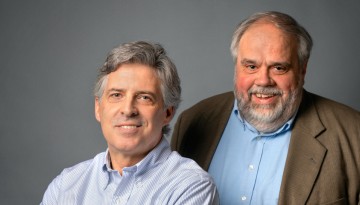
Professors Michael Heise and Marty Wells discuss how they collaborate on empirical legal research, applying advanced data science and statistical analyses to look at legal issues that affect people’s lives as well as examining the judiciary system and how it operates.
The Executive M.B.A./M.S. in Healthcare Leadership, which combines a master’s from the Weill Cornell Graduate School of Medical Sciences with an MBA from the Johnson school, graduated its inaugural class in May.
Cornell has been chosen to host the 51 Pegasi b Postdoctoral Fellowship in Planetary Astronomy, which provides up to eight postdoctoral scientists per year up to $375,000 of support over three years.