Experts to examine the use of generative AI in science

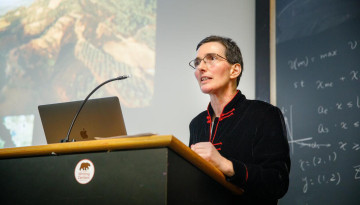
The Assessing and Imagining the Impact of Generative AI on Science Symposium, March 3-5, will feature experts from across academia and industry engaging in discussions on the use and implications of generative AI.

Holding chaos at bay in the quantum world

Researchers have found that quantum systems in a frozen state can be stabilized long enough to be a useful strategy for preserving information before it disappears.

Civic leadership class asks students to consider their purpose

On a Saturday morning in February – the coldest day yet of a cold winter – more than 350 students trekked to Statler Hall for an innovative new course on civics.

Daniel Gold, professor of Asian studies emeritus, dies at 78

Daniel Gold, a professor of Asian studies emeritus in the College of Arts and Sciences, died on Feb. 16 in Ithaca. He was 78.

Literary critic Biodun Jeyifo dies at 80

Biodun “BJ” Jeyifo, a leading literary critic and cultural theorist known for his analysis of modernity and its attendant social and cultural crises, died Feb. 11 in Lagos, Nigeria. He was 80.

Hackathon winners combat ear infections, parasites and animal overpopulation

Products to fight ear infections in dogs, a parasite in cattle and animal population control challenges won top honors at the Feb. 20-22 Animal Health Hackathon at the College of Veterinary Medicine.

Around Cornell

Online module helps students recognize, develop critical thinking

Cornell researchers have developed an online module, running just over an hour in length, that can be offered as a way to instill concepts of critical thinking early in a student’s academic journey.

Abruña honored for chemistry in the public interest

The Gustavus John Esseln Award for Chemistry in the Public Interest from the Northeastern Section of the American Chemical Society honors outstanding achievement in scientific and technical work that contributes to public well-being.

Around Cornell

Proteins organize for extracellular electron transfer

Researchers discovered electron transfer in electroactive bacteria is mediated by CymA proteins’ ability to synchronize and form a biomolecular condensate in the cell’s inner membrane.