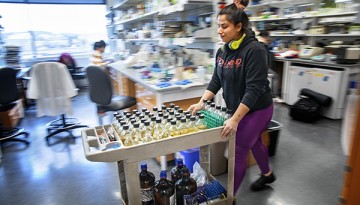
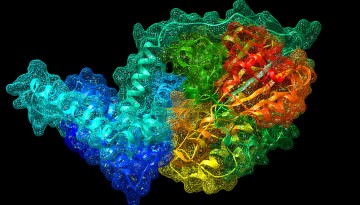
Jennie Sims, the recipient of the Mann Outstanding Graduate Student Award, is probing why, how and when a cell chooses to repair itself, which has implications in cancer research.
A decade ago, Cornell opened the doors of a pioneering new building, a home for innovative and collaborative life sciences research. The $162 million, 265,000-square-foot Weill Hall.
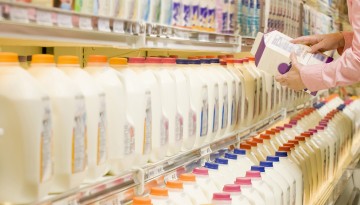
Cornell food scientists are designing the milk carton of the future that will give consumers precise “best by” dates and improve sustainability by reducing food waste.
Donald J. Lisk, M.S. ’54, Ph.D. ’56, professor emeritus of soil chemistry and toxicology and a champion of graduate education, died April 27. He was 88.
The Cornell Presidential Postdoctoral Fellowship Program, which attracts some of the world’s best young talent to Cornell, has chosen eight new fellows.
Students at the Cornell College of Veterinary Medicine can now get a leg up in learning equine anatomy, thanks to a custom-designed app created at the college.
Cornell undergraduates involved in psychology across a number of schools and colleges present their research across a broad array of interests at a May 9 conference in the Physical Sciences Building Atrium.
While sifting through the bacterial genome of salmonella, Cornell food scientists discovered mcr-9, a stealthy jumping gene so diabolical that it resists one of the world’s few last-resort antibiotics.