A team of Weill Cornell Medicine investigators has developed a computer model that will help scientists more efficiently develop protein-destroying therapies, a newer type of treatment that is particularly promising for cancer.
Prostate tumors can rewire amino acid metabolism to override the normal brakes on cholesterol production, a process that may fuel hormone therapy resistance, according to Weill Cornell Medicine researchers.
Researchers used satellite images to identify 1.8 million trees in New York City, a new approach that could be broadly implemented to increase cooling and improve air quality in cities.
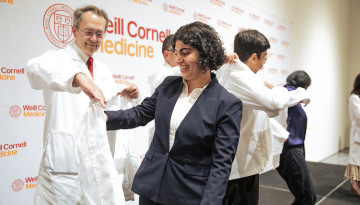
Weill Cornell Medicine celebrated the incoming physician assistant students in the Class of 2028 and first-year medical students in the Class of 2030 Aug. 18 during two White Coat Ceremonies.
Many New York City eighth-graders – particularly those from underserved communities – aren’t applying to academically competitive high schools where they could succeed, according to new Cornell research.
Six new faculty members will join Cornell Tech during the coming year, bringing expertise in AI, machine learning, programming languages, and operations research.