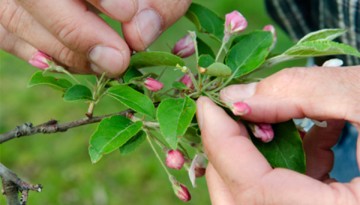
Horticulture assistant professor Kenong Xu Cornell’s New York State Agricultural Experiment Station in Geneva has a new grant to better to understand a key gene in acid production and deliver reliable tools to predict the acid-producing potential of tiny apple seedlings.
Peng Chen, Cornell’s Peter J.W. Debye Professor of Chemistry, has received a 2014 early career award in experimental physical chemistry from the Physical Chemistry Division of the American Chemical Society.
Many tropical mountain birds are shifting their ranges upslope to escape warmer temperatures, but tropical species appear to be more sensitive to climate shifts than species from temperate regions.
The Council for Aid to Education, in an annual survey of colleges and universities, has ranked Cornell University seventh nationally for gifts in 2012-13, when the university received $475 million for that fiscal year.
With door keys in hand and research ready for a scientific bench, startup business Ionica Sciences became the newest tenant Feb. 5 at Cornell's Kevin M. McGovern Family Center for Venture Development in the Life Sciences.
Maryam Shanechi is bringing brain-machine interfaces to the next level: Instead of signals directing a device, she hopes to help paralyzed people move their own limb, just by thinking about it.
Making lifelike wax molds of their own faces to replicate Roman funeral masks, Cornell researchers explored the significance of materials in the ancient practice of remembering deceased ancestors.
The promise and peril of 3-D printing, and particularly, the printing of electronics and other active, integrated systems, was the topic of a Feb. 14 American Association for the Advancement of Science talk by Hod Lipson, associate professor of mechanical and aerospace engineering and of computer science.