Artificial intelligence-powered writing assistants that autocomplete sentences or offer “smart replies” not only put words into people’s mouths, they also put ideas into their heads, according to new research.
Iris Packman ’06 of the ILR School’s Climate Jobs Institute will share with the Ithaca community her expertise on ways to meet the goals of climate justice, sustainability and carbon neutrality by 2030.
Eun-Ah Kim, professor of physics, and Google researchers report the first demonstration of two-dimensional particles, called non-Abelian anyons, that are the key ingredient for realizing topological quantum computing, a promising method of introducing fault resistance to quantum computing.
A new study led by Weill Cornell Medicine and NewYork-Presbyterian investigators has found that the risk of long COVID and its symptoms present very differently across diverse populations and suggests that further investigation is needed to accurately define the disease and improve diagnosis and treatment.
Brian Kaufman leverages his learning from the Cornell Nolan School of Hotel Administration in managing Blackstone's hospitality assets. His leadership of social change initiatives is adding new dimensions to his career.
A new cycle of Einaudi Center seed grants will help faculty from six colleges across Cornell tackle issues ranging from the health of endangered wild dogs to the spread of misinformation through social media.
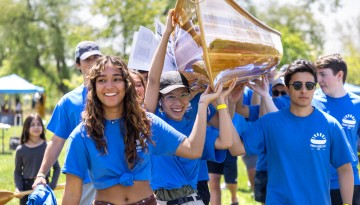
On May 7, Cornell students presented a handmade canoe to Hickory Edwards, Onondaga Nation Turtle Clan member and founder of the Haudenosaunee Canoe Journey, a program that guides Indigenous youth through ancestral waterways in upstate New York.