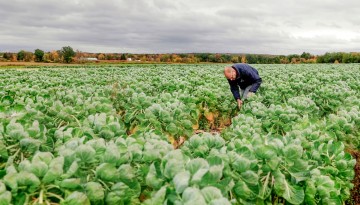
A $1M award will support Upstate 2.0, which aims to grow the regional economy in upstate New York while helping to realize the state and nation’s goal of a net-zero carbon economy.
Norman Potter ’50, an award-winning teacher and mentor who wrote the foundational textbook “Food Science,” died March 6 in Lexington, Kentucky. A professor emeritus of food science, Potter was 96.
Cornell researchers have developed a robot called ReMotion that occupies physical space on a remote user’s behalf, automatically mirroring the user’s movements in real time and conveying key body language that is lost in standard virtual environments.
Comparing Britain, the United States and France with the Soviet Union, Nazi Germany and the Islamic Republic of Iran, Richard Bensel uncovers a paradox at the heart of every modern state founding.
A new method for analyzing protein crystals – developed by Cornell researchers and given a funky two-part name – could open up applications for new drug discovery and other areas of biotechnology and biochemistry.
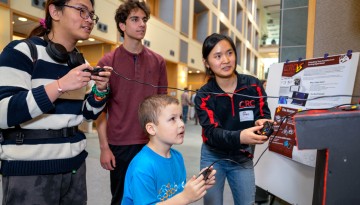
Bits On Our Minds technology showcase, held April 27 in the Duffield Hall atrium, featured cutting-edge technology projects from across the university.
Patients with HIV had similar treatment outcomes to patients without HIV when treated for mpox with an antiviral drug called tecovirimat, according to a new study.
As part of a new cross-college initiative designed to accelerate engineering innovations in medicine, Cornell Engineering is piloting an M.D.-M.Eng. program that allows medical students at Weill Cornell Medicine to earn a one-year professional Master of Engineering degree.
The Big Red was awash in tie-dye May 8 as Dead & Company came to Barton Hall for a jubilant benefit show that had multiple generations celebrating the return of members of the Grateful Dead to the site of one of their most historic shows.
An enthusiastic audience of 100 Cornellians celebrated academic achievements and community at the Office of Academic Diversity Initiatives’ annual Honors Award Ceremony on May 5.
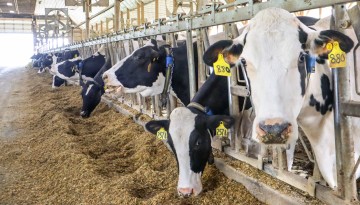
Cutting-edge, data-driven agricultural technologies and precision management strategies designed for the farm of the future will be developed, evaluated and demonstrated, thanks to a four-year, $4.3 million U.S. Department of Agriculture grant.