Master gardeners test for best NYS vegetable varieties
By Caitlin Hayes, Cornell Chronicle
Gardeners experiment every time they sow a new vegetable, and sometimes it fails: blighted tomatoes, moth-eaten cabbage, plants that never flower.
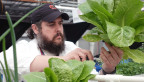
“That’s part of gardening,” said Noel Harradine, a master gardener volunteer with Cornell Cooperative Extension (CCE) Wayne County, one of more than 100 CCE gardeners across the state working to take some trial and error out of the process by testing varieties to find what grows best in New York.
Harradine’s work is part of CCE’s statewide Vegetable Variety Trial Garden program, a long-standing initiative to help New York gardeners choose the best-performing varieties for their regions. Across 37 counties this year, master gardener volunteers have sown select vegetables in CCE garden beds and are now collecting data and evaluating vegetables for taste, yield and ease of growing. The observations are collected in a public web forum and shared with Cornell researchers and extension staff, as well as the sponsoring seed company.

Laurie VanNostrand (right), Cornell Cooperative Extension master gardener coordinator in Wayne County and statewide coordinator for the Vegetable Variety Trial Garden project, chats with a master gardener volunteer at a plant pick-up day on campus on May 12.
“This is one of our signature programs for master gardeners,” said Ashley Miller Helmholdt, the adult program leader for CCE’s Cornell Garden-Based Learning, which supports the master gardener volunteer program statewide. “It connects people, engages the community and of course promotes healthy food access.”
The vegetable trial gardens, most of which are located on-site at CCE county offices, provide continuing education for master gardener volunteers as well as demonstration plots for the public, from 4-Hers to seniors, with hundreds of visitors to the gardens each year. The master gardeners, along with posted signs, provide information about the crop as well as gardening tips, and the vegetables are used for shared meals at meetings and community events, with the surplus often given to local food pantries. In 2024, 226 pounds of vegetables were donated through the program.
The trial informs research on campus. It dovetails especially with Assistant Professor Greg Vogel’s work, which is dedicated to breeding optimal vegetable crops for New York state and extending that knowledge to stakeholders and the public. Vogel, in the School of Integrative Plant Science in the College of Agriculture and Life Sciences, said master gardeners tell his team what they want from their vegetable varieties and what pests and diseases they’re facing at home.
“That information is really helpful for us to set our breeding priorities,” Vogel said. “The vegetable variety program allows for a two-way movement of information, from the community to campus and then back, because the master gardeners are serving as educators in their communities.”
For the ‘joy of it’
The trial program began in 2013 as a companion to Vegetable Varieties for Gardeners, a 50 year-old database-turned-website created by Cornell Cooperative Extension that allows any gardener to rate the success of varieties in their region. The highest rated vegetables are added to a list that’s distributed to CCE offices across the state, so it can be passed on to the public.
“A lot of people from out of state contact us about the website – because they’ve never seen anything like it,” said Laurie VanNostrand, CCE master gardener coordinator in Wayne County and statewide coordinator for the vegetable trial project. “It’s a pretty unique resource for New York state gardeners.”
For the last four years, the selected vegetables have come from particular cultures or regions – last year from the African diaspora, for example, and this year from the Mediterranean. Marcie Foster, CCE educator in Schoharie and Otsego counties, said the themes have expanded palates and perspectives and allowed some of her master gardener volunteers to connect to their own lineages.
“It’s broadening our understanding of different cultures and regions through growing and eating food, which I think is a unique thing, especially in upstate New York,” Foster said. “And then it can be even more special when someone can see and grow something from seed that maybe their grandmother used.”
In recent years, gardeners have raved about the “Cosmonaut Volkov” tomato from Eastern Europe, yellow cabbage collards from the African diaspora, and a ”Jibai Shimoshirazu” cucumber from Eastern Asia. And there have been surprises: white velvet okra thriving in upstate New York, the sweetness of a small, brown “chocolate tomato” and the commonalities between cultures.
“Every culture seems to have a tomato, a basil, a pepper,” Harradine said. “I’ve definitely enjoyed learning about the different cultural practices and trying things I never would have grown on my own.”
Harradine, a retired special education teacher who lives alone, said the program – and being a master gardener volunteer generally – keeps her connected.

Howard Rice, senior technician in the School of Integrative Plant Science, leads a demonstration on grafting tomatoes for master gardener volunteers on May 12.
“I think the social aspect is the biggest part of it, and the constant learning,” Harradine said. “I meet all different types of people, but we have this thing in common, and every month, we’re learning.”
The trial also connects master gardeners to Cornell’s main campus – Vogel and Cornell Garden-Based Learning host an annual event each spring where CCE educators and master gardeners can pick up starter seedlings, grown by Vogel’s lab. This year, Howard Rice, senior technician in Vogel’s lab, taught the group how to graft tomato plants, a way of combining species to get the best traits of both.
Master gardener volunteer Cathie Barnes with CCE Wayne County found it “refreshing.”
“Connecting with them was great – they’re young, enthusiastic, and they’re sharing their knowledge base and teaching people about agriculture,” she said.
Helmholdt said the number of counties participating in the trial has steadily grown in recent years.
“There’s a big surge in people wanting to learn these skills that maybe their grandparents knew, maybe during the Depression, and now we’re in another period of economic upheaval,” she said. “And there’s just a real interest in food, the taste of food and the joy of it.”
As master gardeners, Barnes and Harradine enjoy sharing an activity that has had such a positive impact on their lives.
“To actually be able to eat what you’ve planted and grown – it just makes me feel that I’ve come full circle,” Barnes said. “I’m proud that I put the labor in and that it’s actually something delicious and nutritious for me and my family – there’s so much reward in that.”
Media Contact
Get Cornell news delivered right to your inbox.
Subscribe