A fungus known to decimate populations of gypsy moths creates “death clouds” of spores that can travel more than 40 miles to potentially infect populations of invasive moths, according to a new study.
Cornell University’s Atkinson Center for a Sustainable Future and Environmental Defense Fund have announced five new research projects addressing urgent public health and environmental issues.
Fourteen Cornell students and recent alumni are setting out this fall for destinations around the world, thanks to grants from the Fulbright U.S. Student Program.
Lynn Wooten joined Cornell July 1 as the David J. Nolan Dean and a professor of management and organizations in the Charles H. Dyson School of Applied Economics and Management. She recently discussed her new role, her sense of connection to Cornell’s mission and her strategic vision for the school.
Six clean-tech companies working at the intersection of technology and sustainability - including one co-founded by a Cornell graduate - will use 76West competition prize money to help build the clean energy economy in the Southern Tier.
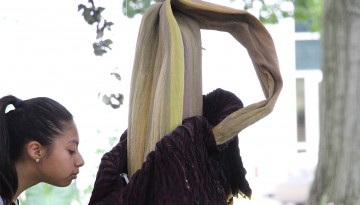
Carolus, one of the College of Agriculture and Life Sciences' Titan arums (Amorphophallus titanum), also known as a corpse flower, bloomed in Minns Garden - the first time one of the flowers ever bloomed in a region outside of the tropics.
What do cat carriers, multifaceted keyboards and genetically engineered bacteria have in common? They are all products brought to life during this year's summer hardware program at Rev: Ithaca Startup Works.
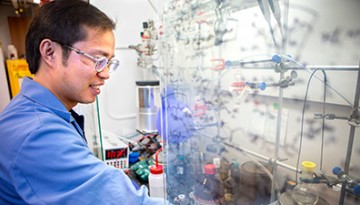
Give your medicine a jolt. By using a technique that combines electricity and chemistry, future pharmaceuticals soon may be easily scaled up to be manufactured in a more sustainable way.
Cornell researchers are using drone technology to more accurately measure surface reflectivity on the landscape, a technological advance that could offer a new way to manage climate change.