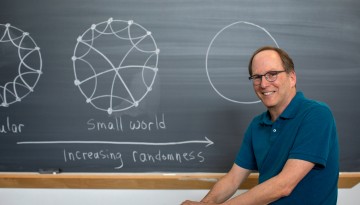
In 1998, Professor Steven Strogatz and then-student Duncan Watts, Ph.D. '97, published a model that launched the field of network science – the results of which are ubiquitous in today’s world.
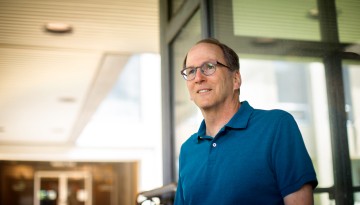
Bolstering its commitment to broader engagement, the College of Arts and Sciences has established the Winokur Professorship in the Public Understanding of Science and Mathematics with mathematician Steven Strogatz as the inaugural holder of the chair.
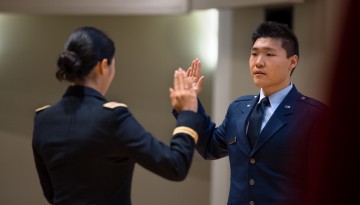
Graduating members of the Tri-Service Brigade received commissions to begin their military service – including the brigade’s first commission into the U.S. Space Force – at a May 26 ceremony in Statler Auditorium.
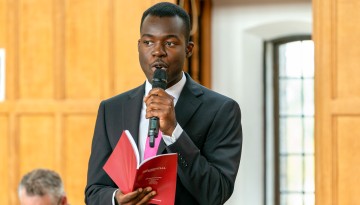
In a two-day celebratory program, Merrill Scholars recognized the high school teacher or mentor who most impacted their early education and the Cornell faculty or staff member who contributed most significantly to their college experience.
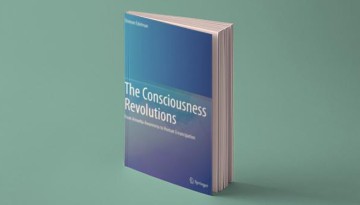
Shimon Edelman traces the evolution of consciousness through his newest book, “The Consciousness Revolutions: From Amoeba Awareness to Human Emancipation.”
Cornell Atkinson will provide $1.6 million in seed funding to support research teams across nine colleges and 22 departments, many with external partnerships.
Cornell is breaking new ground in electron beam research with the HERACLES beamline, a state-of-the-art electron gun in Newman Lab that mimics the harsh environments of the world’s largest particle colliders.
Generative artificial intelligence threatens to undermine trust in democracies when misused, but may also be harnessed for public good, Sarah Kreps told the President’s Council of Advisors on Science and Technology on May 19.