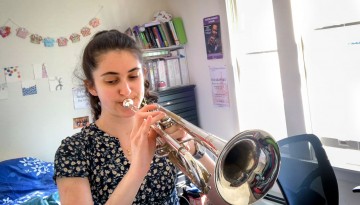
On May 15, Lucy Fitz Gibbon and husband Ryan McCullough will release their first collaborative album, “Descent/Return,” featuring musical settings of poetry, some of which are particularly relevant today.
The Cornell High Energy Synchrotron Source will partially restart operations in June to conduct research related to treatment of SARS-CoV-2, the virus that causes COVID-19.
Amid the challenges of shifting to virtual learning, students and faculty found opportunities for innovation, connection and intellectual growth. Here are snapshots of six courses that took creative approaches to their online formats.
Sophomores in the Milstein Program in Technology and Humanity were supposed to spend the summer of 2020 at Cornell Tech, but due to the pandemic, that program has moved online.
Historian Barry Strauss notes that plagues and epidemics have often been linked to wars. The current pandemic will highlight the fragility of society and significantly influence U.S. politics – with unknown consequences – and the U.S.-China relationship, he says.
The proliferation of medical misinformation on social media and the human experience of social distancing are among the pandemic-related topics to receive rapid response grants from the Cornell Atkinson Center for Sustainability.
The Office of the Vice Provost for Research has announced a new seed grant mechanism to fund preliminary investigations into medical and biological aspects of SARS-CoV-2, the virus that causes COVID-19.
Cornell researchers used a form of a rotational oscillation, called orthogonal shear, to manipulate the solidification of thickening fluids under compression and extension and explore how these materials solidify.
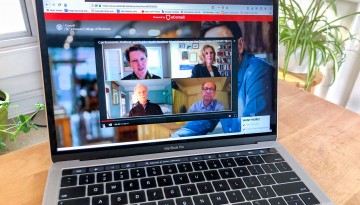
Cornell thought leaders discussed the balance between public health and economic health, and the role government plays in finding a path forward during COVID-19 in a webinar April 30.