The Cornell High Energy Synchrotron Source will create a new materials research subfacility, thanks to $7.1 million in funding from the Air Force Research Lab, to facilitate X-ray analysis of new and existing materials.
Sixty years after joining Cornell’s faculty, Anil Nerode, the Goldwin Smith Professor of Mathematics in the College of Arts and Sciences, is believed to be the longest-serving professor in Cornell history.
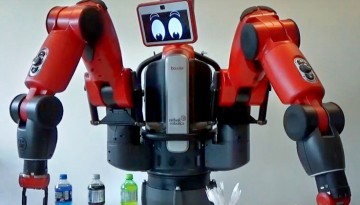
A Cornell-led team was recently awarded a $2.5 million grant from the Office of Naval Research to develop a computational model of how humans form and update their memories of robots.
Barbara Graziosi, a professor of classics at Princeton University, will deliver the three-part Townsend Lectures, Sept. 10, 13 and 17, on the theme of “Homecoming and Homemaking in the Ancient Mediterranean.”
Lakes of liquid methane that pock the landscape on Saturn’s moon Titan were likely formed by explosive, pressurized nitrogen just under the moon’s crusty surface.
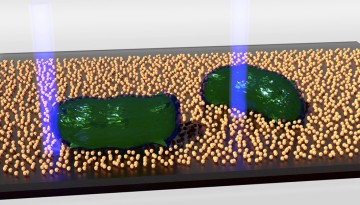
The U.S. Department of Energy has awarded an interdisciplinary team of Cornell researchers $2 million to study the combination of inorganic semiconductor nanoparticles and bacterial cells for more efficient bioenergy conversion.
The drawn-out process for diagnosing Lyme disease could become a thing of the past – good news for the thousands of people each year who get the tick-borne illness.
Sturt Manning, Nancy Green and Nicole Milano have received grants from the National Endowment for the Humanities for field research, cultural heritage and preservation projects.
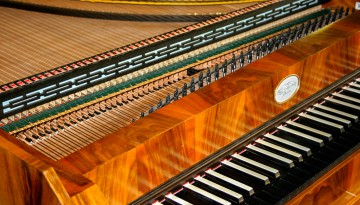
A new hub for historical keyboard studies launches at Cornell with the opening of the Cornell Center for Historical Keyboards, 726 University Ave. An opening event is planned for Sept. 6-7.