By applying scientific principles used to create models for understanding cell biology and physics to the challenges of cosmology and big data, Cornell researchers have developed a promising algorithm to map a multifaceted set of probabilities.
English professor Jane Juffer looks at children’s television, online gaming and political expression in her new book, “Don't Use Your Words! Children’s Emotions in a Networked World.”
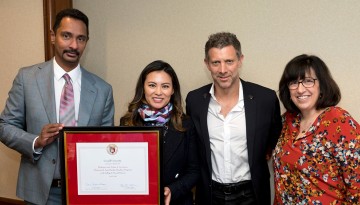
A $10 million gift from alum Adam J. Levinson ’92 and wife Brittany Levinson will expand opportunities for Cornell students to study and explore the China and Asia-Pacific region and its global impacts.
A Cornell-led team has developed a way to use machine learning to analyze data generated by scanning tunneling microscopy, yielding new insights into how electrons interact and showing how machine learning can be used to further discovery in experimental quantum physics.
Henry Crans, a mainstay in facilities at Cornell for 50 years, retires on June 30. The College of Arts and Sciences will hold a drop-in retirement reception for Crans June 25, 1-4:30 p.m. in Klarman Atrium.
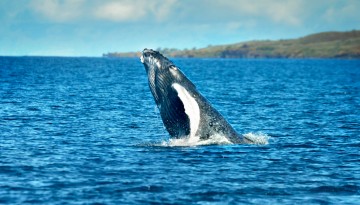
This spring, senior music lecturer Annie Lewandowski worked with Google Creative Lab on a project to develop artificial intelligence that can recognize patterns in humpback whale songs.
Travelers to Reunion were introduced to the origins and evolution of travel photography in a talk June 6 by Andrew Moisey, assistant professor of the history of art and visual studies.
The American Astronomical Society Division for Planetary Sciences will honor Cornell astronomy professor Phil Nicholson with the 2019 Harold Masursky Award.
Published research by chemist Nozomi Ando, performed at CHESS, has identified a new vulnerability in bacteria that offers a possible avenue for dealing with antibiotic resistance.