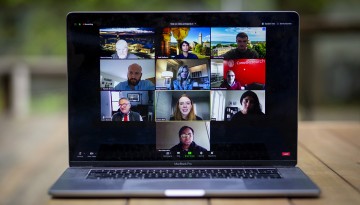
The Cornell Defender Program virtually teamed undergraduates and law students with trial attorneys to support indigent defense in Tompkins County and a more diverse pipeline of students interested in law careers.
Cornell’s Adult University is hosting free and pay-to-view live online seminars open to the public this fall, beginning with “The 2020 Presidential Election – an Online Seminar.”
Three New York state companies have been chosen to participate in the Cornell Center for Materials Research JumpStart Program, through which they will collaborate with faculty members to develop and improve their products.
Researchers led by Hening Lin have found a new way to potentially treat inflammatory bowel disease, as well as other autoimmune disorders, by targeting a mechanism that regulates the signaling pathway that enables inflammation to occur.
Professor Jonathan Boyarin studied at Mesiytha Tifereth Jerusalem, New York’s oldest institution of rabbinic learning. His new book describes his experiences in “Yeshiva Days: Learning on the Lower East Side.”
Emmy-nominated filmmaker Jeffrey Palmer, assistant professor of performing and media arts in the College of Arts and Sciences, tells Native Americans’ untold stories while pushing the limits of documentary film.
Cornell astronomy professors Alex Hayes and Jonathan Lunine have been named chairs for two of the six panels for the Planetary Science and Astrobiology Decadal Survey 2023-2032.
Saul Teukolsky, the Hans A. Bethe Professor of Physics in the College of Arts and Sciences, has won the American Physical Society’s 2021 Einstein Prize for outstanding achievement in gravitational physics.
Voteology, a site helping students assess where their vote will have the most impact, won the inaugural Pitch for the People, a virtual competition focused on the humanities and social sciences.