The discovery made by two doctoral students could have future implications for human health, setting a path for research into understanding brain function.
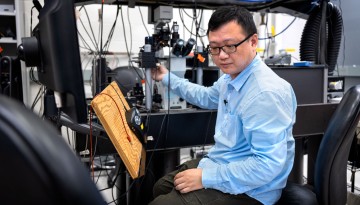
Cornell researchers designed a micro-sized artificial cilial system that could eventually enable low-cost, portable diagnostic devices for testing blood samples, manipulating cells or assisting in microfabrication processes.
Cornell startup Antithesis Foods and Bactana were awarded NSF small-business grants, as Guard Medical raises $11 million in Series B investments and C2i launches a disease test in Europe.
Through their work on the dynamics of liquid mixtures, scientists have developed a new approach to the problem of cleaning sensitive, electronic surfaces.
Scientists soon will see Earth’s atmospheric dust in high-resolution, thanks to new spectrometer expected to launch June 7 aboard a SpaceX rocket to the International Space Station.
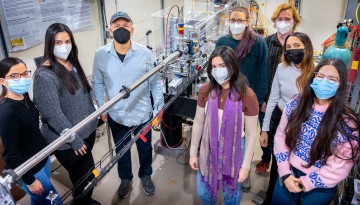
Researchers at CHESS examine proteins that reveal new ways to fight cancer, battery cells that enable a charge far beyond current capabilities and structural materials that enable space travel to improve with lightweight, yet more structurally sound components.
So long, natural gas heat: Let the Earth warm little fingers and toes. Building a new, environmentally friendly heating and cooling system at the Cornell Child Care Center will start in late summer.
As he accepted his Distinguished Alumni Award from Cornell Engineering on May 13, Robert F. Smith ’85 announced a new gift of $15 million for engineering student aid.
Declaring this the “decisive decade” for climate action, Cornell launched The 2030 Project: A Climate Initiative, which will mobilize world-class faculty to develop and accelerate tangible solutions to the climate challenge.