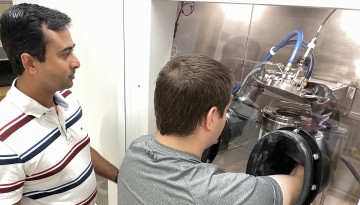
A new metal organic chemical vapor deposition system will be used to engineer and study gallium oxide, an important material for the future of high-powered electronics.
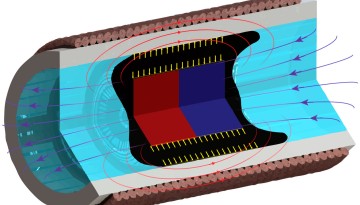
A collaboration between Cornell researchers and the U.S. Army Research Laboratory has leveraged hydrodynamic and magnetic forces to drive a rubbery, deformable pump that can provide soft robots with a circulatory system, in effect mimicking the biology of animals.
Smart thermostats may be falling into a dumb trap. While these devices save homeowners money, Cornell engineers found they may be prompting unintentional energy spikes on the grid.
Producing biomaterials that match the performance of cartilage and tendons has been an elusive goal for scientists, but a new material created at Cornell demonstrates a promising new approach to mimicking natural tissue.
The Autonomy and Mobility in Engineered and Natural Environments Workshop at Cornell Tech highlighted research from the smart cities and urban technology academic communities in Ithaca, NYC and beyond.
Activities beyond campus – such as business air travel, student commutes and purchases like lab equipment – account for more than 60% of Cornell’s carbon emissions, according to a new analysis.
Top private and public sector leaders, academics, experts, and practitioners will meet for a workshop at Cornell Tech focusing on new methods of infrastructure delivery. The issue is especially timely because of the $1.2 trillion infrastructure bill signed into law by President Biden.