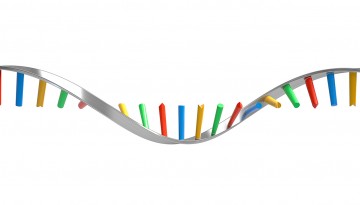
A Cornell research team led by Ben Cosgrove used a new cellular profiling technology to probe and catalog in a “muscle regeneration atlas,” the activity of almost every possible kind of stem cell involved in muscle repair.
Yunyun Wang ’20, a double major in the College of Arts and Sciences and in the College of Engineering, has been named a Newman Civic Fellow by Campus Compact, a national coalition committed to the public purposes of higher education.
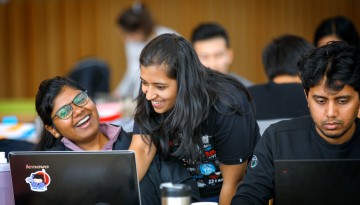
Students in fields ranging from computer science and engineering to business, agriculture and animal science convened at the second Digital Agriculture Hackathon, Feb. 28-March 1, with a shared purpose: to combine their disparate skills to brainstorm ways to make the world a better place.
NYSERDA will give Cornell $1.65 million in incentives for energy studies and project work to develop a smaller carbon footprint for campus, toward the university’s net-zero carbon goal by 2035.
Projects aiming to combat online harassment of women and improve the computer models used to predict disease were among the five at Cornell to receive 2019-2020 Google Faculty Research Awards.
Recyclable plastic containers with the No. 2 designation could become even more popular for manufacturers as plastic milk jugs, dish soap and shampoo bottles may soon get an environmental makeover.
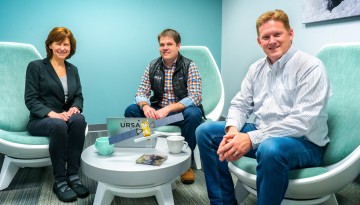
Ursa Space Systems, a geospatial intelligence agency located in Ithaca and founded by alumni Adam Maher and Derek Edinger, and Julie Baker, recently obtained $15 million in Series B funding.
The four faculty teams that received funding support through the President’s Visioning Committee on Cornell in New York City have conducted cross-campus workshops, hosted interdisciplinary talks and expanded their outreach.
NASA’s Mars InSight lander is now serving up the red planet’s meteorological secrets: Gravity waves, dust devils and the steady, low rumble of infrasound.