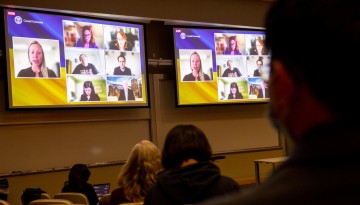
Local officials, graduate students and faculty held a simulation exercise at the Cornell Jeb E. Brooks School of Public Policy on March 12 to work through questions around autonomous vehicles.
Nancy Schlichting '79 is a pioneering leader the healthcare industry, an enthusiastic supporter of the Sloan Program in Health Administration and now an honoree in the Modern Healthcare Hall of Fame.
An analysis of newly released census data by the Cornell Program on Applied Demographics shows how the pandemic’s onset influenced populations in each New York state county.
Formerly incarcerated men deal with uncertainty around whether to use their prison credentials or not when searching for work, according to new findings from Brooks sociologist Sade Lindsay.
Policymakers, legislators and military strategists must prepare for the consequences of other countries and actors such as the Islamic State using drones, according to panelists in a Cornell discussion March 14.
Junior Nate Reilly jumpstarts his own artistic career while working to enhance the arts from a systemic and policy-oriented lens as a participant in the Cornell in Washington program.
Clarity about the goals of sanctions against Russia will be key to attempts to de-escalate the conflict, Cornell faculty experts said during a March 4 panel discussion.
Scholars have overlooked tenant organizations as a crucial source of political power in the most precarious communities, according to new research co-authored by Jamila Michener.