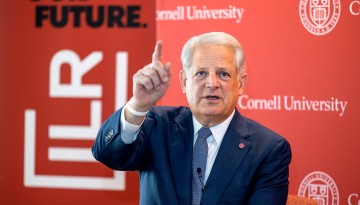
To address the fragility of American democracy, the Institute of Politics and Global Affairs at the Cornell Jeb E. Brooks School of Public Policy is bringing together influential political leaders, policymakers and experts for a May 24 summit.
Awards from the Mario Einaudi Center for International Studies will support faculty-led research and international events, send graduate students to research destinations around the world and connect undergraduates with in-person and virtual internships from Ecuador to Zambia and beyond.
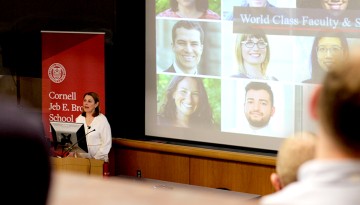
The Cornell Jeb E. Brooks School of Public Policy is about to conclude its first academic year. In a State of the School address to faculty and staff, Dean Colleen Barry outlined accomplishments from that year and new initiatives the school is about to launch. She also described the school's long-term goals including the goal of becoming one of the nation's pre-eminent public policy schools.
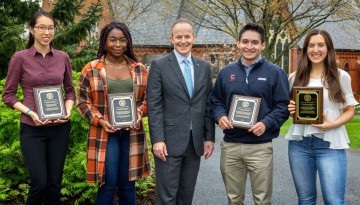
Four students have received the 2022 Cornell Campus-Community Leadership Award, an annual honor given by the Division of University Relations to graduating seniors who have shown exceptional town-gown leadership and innovation.
Misperceptions of marginalized and disadvantaged communities’ level of concern regarding COVID-19 and other issues could undermine cooperation and trust needed to address collective problems, according to new Cornell-led research.
Imagining superheroes and sharing leftovers, building a library and embarking on a new educational adventure - that's how four Cornell Jeb E. Brooks School of Public Policy students plan to use funds they received through the Contribution Project.
"I saw what I am capable of when I am challenged" - that's what University of Buffalo freshman Donovan Blount says about a course developed at Cornell by two professors in the Jeb E. Brooks School of Public Policy. The leader of a national education equity organization says professors Maria Fitzpatrick and Matthew Hall are "academic heroes."
Research by Cornell Institute for Public Affairs students highlights unsustainable cost increases challenging rural ambulance services in upstate New York and beyond, and offers solutions.
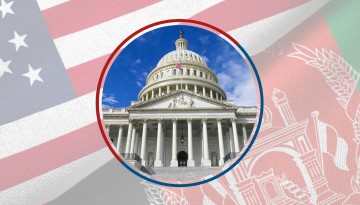
The Bipartisan Policy Review is an annual publication from the Institute of Politics and Global Affairs at the Cornell Jeb E. Brooks School of Public Policy. This edition features thought-provoking analysis of the direction of U.S. foreign policy following the military withdrawal from Afghanistan and the 20th anniversary of the 9/11 attacks.