Contributions unveiled tools for analyzing environmental and health interventions, matching images to architectural plans, and generating realistic 3D scenes with unprecedented efficiency.
Cornell researchers tallied the environmental benefits of New York City’s congestion pricing program and found air pollution dropped by 22% in Manhattan, with additional declines across the city’s five boroughs and surrounding suburbs.
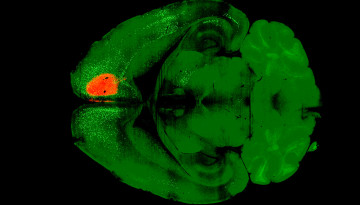
An international collaboration led by Cornell researchers used a combination of psilocybin and the rabies virus to map how – and where – the psychedelic compound rewires the connections in the brain.
Electrons can be elusive, but Cornell researchers using a new computational method can now account for where they go – or don’t go – in certain layered materials.
More than 75 employees were honored in this year’s ceremony, representing Cornell’s Ithaca campus as well as Weill Cornell Medicine in New York City and Weill Cornell Medicine-Qatar.
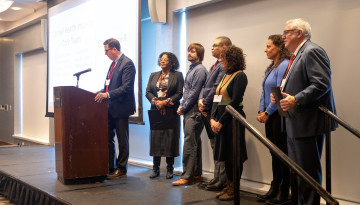
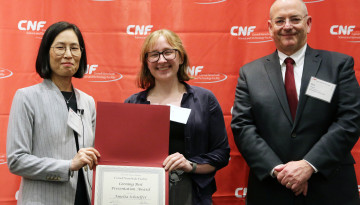
Cornell’s NanoScale Science and Technology Facility (CNF) convened researchers, industry partners, and national collaborators for its 2025 Annual Meeting on November 18, highlighting advances across photonics, quantum devices, semiconductor fabrication, sustainability, and life sciences.
Cornell researchers have developed a new transistor architecture that could reshape how high-power wireless electronics are engineered, while also addressing supply chain vulnerabilities for a critical semiconductor material.
In 2025, four companies with Cornell-originated technologies — SafetyStratus, Bactana Corporation, Guard Medical and Halo Labs — were acquired by global corporate partners, allowing Cornell technologies to reach broader markets.
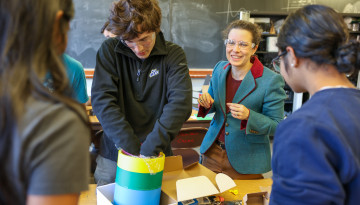
Cornell Engineering is rapidly becoming a leader in engineering education research, a field dedicated to designing effective education systems and learning experiences for students. The insights emerging from this work have the potential to redefine engineering education on campus and far outside it.