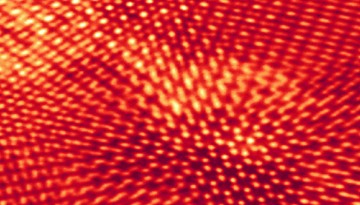
Cornell researchers developed a new form of electron microscopy that uses complex algorithms to achieve faster, more efficient imaging – and they obtained the best results by defocusing their detector and blurring the beam.
Susan Daniel and Gary Whittaker discuss their collaborations and others across Cornell’s campuses that are working to better understand the COVID-19 virus.
Cornell Atkinson has awarded seven Academic Venture Fund seed grants, totaling $1.1 million, for projects that engage faculty from eight Cornell colleges and 16 academic departments.
Five doctoral candidates were inducted into the Cornell chapter of the Bouchet Graduate Honor Society, which recognizes outstanding scholarly achievement and promotes diversity and excellence in doctoral education.
After being defunded by a company with rights to its intellectual property, development of a pediatric heart-assist device has been revived at Cornell with the help of a $4.7 million defense department grant.
Cornell has announced its 2020 cohort of Commercialization Fellows, who will spend a fully funded summer and semester exploring market viability for new technologies, including novel robots and a vaccine delivery system.
A Cornell team developed a new imaging technique that is fast and sensitive enough to observe critical spin fluctuations – which are highly correlated electron spin patterns – in two-dimensional magnets.
Cornell has earned a platinum sustainability rating – the top status – from an international group that tracks environmental stewardship for over 1,000 college campuses.