Four New York state companies have been selected for the Cornell Center for Materials Research JumpStart Program, through which they will collaborate with faculty members to develop their products.
Eleven Cornell students worked all summer to move their businesses forward, thanks to the Marla and Barry ’90 Beck Entrepreneurship Fellows Program, which supports students in their entrepreneurial pursuits.
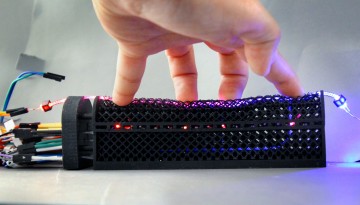
A new stretchable optical lace creates a linked sensory network that would enable robots to sense how they interact with their environment and adjust their actions accordingly.
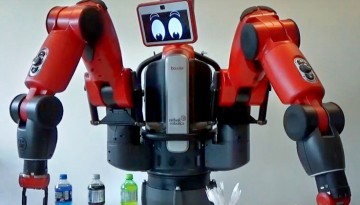
A Cornell-led team was recently awarded a $2.5 million grant from the Office of Naval Research to develop a computational model of how humans form and update their memories of robots.
The Sustainable Cornell Council, announced Sept. 9, will direct and coordinate Cornell’s role as an international leader in addressing climate change and promoting sustainability. It replaces two previous sustainability groups.
Lakes of liquid methane that pock the landscape on Saturn’s moon Titan were likely formed by explosive, pressurized nitrogen just under the moon’s crusty surface.
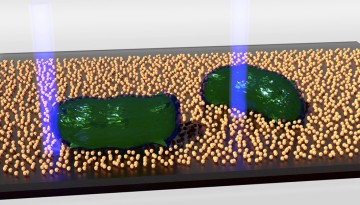
The U.S. Department of Energy has awarded an interdisciplinary team of Cornell researchers $2 million to study the combination of inorganic semiconductor nanoparticles and bacterial cells for more efficient bioenergy conversion.
The drawn-out process for diagnosing Lyme disease could become a thing of the past – good news for the thousands of people each year who get the tick-borne illness.