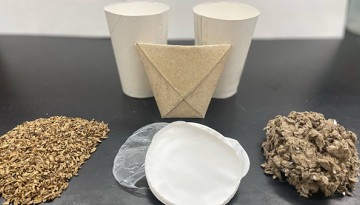
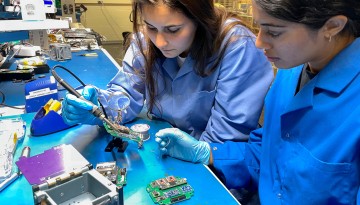
The Cornell Center for Materials Research (CCMR) is helping four small businesses advance their technology to grow the innovation economy in New York state.
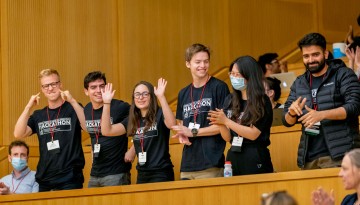
The hackathons, run by Entrepreneurship at Cornell, are open to undergraduate and graduate students from any field and major and take place from Friday evenings through Sunday afternoon.
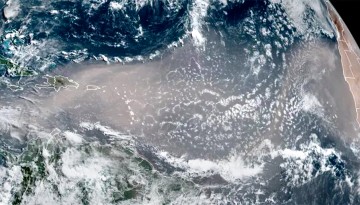
Plant pathogens can hitch rides on dust and remain viable, with the potential for traveling across the planet to infect areas far afield, a finding with important implications for global food security and for predicting future outbreaks.
Cornell researchers used X-ray diffraction to study how microscale phenomena such as bending and fragmentation emerge in the nickel-based superalloy IN625 as it is being 3D printed.
Cornell is spearheading the New York Consortium for Space Technology Innovation and Development – a new initiative aimed at bolstering U.S. space technology research and manufacturing by uniting industry, academic and government partners.
The 18 students in the College of Engineering's Kessler Fellows program recently completed funded summer internships at a startup of their choice. Four interns went into depth about their experiences.
To bridge the data gap between volcanologists and atmospheric scientists, Cornell researchers have depicted volcanic ash samples to learn how this tiny dust plays a big climate role.
Glaciers could become a powerful tool for monitoring some volcanoes, according to new Cornell research that shows for the first time how the altitude of glaciers could signal the threat of an eruption.
Vesna Bacheva, recipient of a 2023 Schmidt Science Fellowship, collaborates with CROPPS to pioneer innovative technologies and models aimed at investigating the signaling and nutrient transport processes within plants.