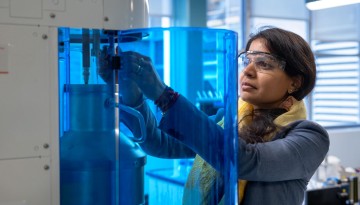
Cornell’s Greeshma Gadikota will partner with Stillwater Critical Minerals to develop environmentally rigorous techniques to help the company extract a steady supply of elements.
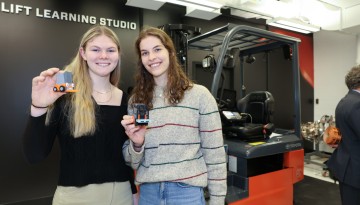
The Forklift Learning Studio, developed in partnership with Toyota Material Handling, provides students taking mechanical engineering courses with a place to apply curriculum on real products.
The Bowers Undergraduate Research Experience (BURE) is a paid summer research opportunity with Cornell faculty, allowing students to develop new skills and gain insights into careers in research.
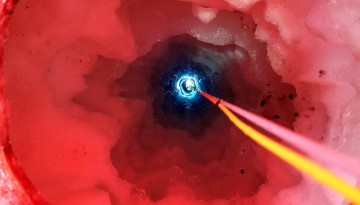
The Icefin team’s observations revealed more than a century of geological processes beneath the Ross Ice Shelf near where it meets Kamb Ice Stream, and will inform models of sea-level rise.
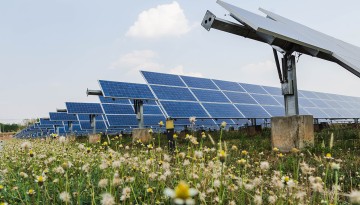
In the face of climate change, growing commercial crops under acres of solar panels is a potentially efficient use of agricultural land that can boost food production and improve panel longevity.
A simple model that simultaneously simulates swarming behaviors and synchronized timing takes a step toward engineering microrobots and furthering our understanding of such phenomena in biology.
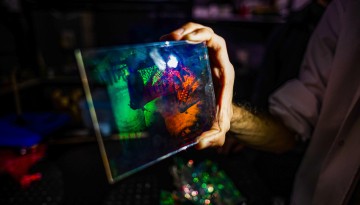
A yearslong effort to launch Cornell-made satellite technology into a neighboring solar system is making a terrestrial stop at the Intrepid Sea, Air and Space Museum in New York City with a new exhibit: “Postcards from Earth: Holograms on an Interstellar Journey.”
Researchers studying statistics applications in systems biology and next-generation wireless technology are among the nine Cornell faculty members who’ve received National Science Foundation Faculty Early Career Development Awards.
Cornell students heading to Vanderbilt University for the Clinton Global Initiative University 2023 Annual Meeting will work on solutions for challenges facing their campuses, communities and the world.