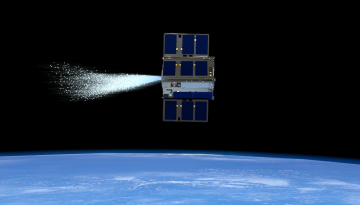
Engineering professor Elaine Petro received an Air Force Office of Scientific Research Young Investigator Program Award to research spacecraft propellants.
First-of-their-kind observations reveal new details about melting at the grounding line of the vulnerable Thwaites Glacier that is contributing to its retreat and potentially to sea-level rise, according to Cornell researchers and international collaborators.
Assistant professors Eshan Chattopadhyay, Debanjan Chowdhury, Andrew Musser, Angeline Pendergrass and Andrej Singer have won 2023 Sloan Research Fellowships from the Alfred P. Sloan Foundation.
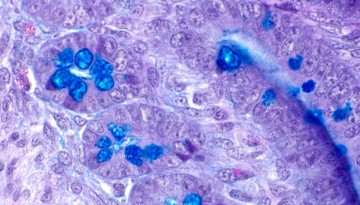
Metal oxide nanoparticles – commonly used as food coloring and anti-caking agents in commercial ingredients – may damage parts of the human intestine, say Cornell and Binghamton University scientists.
Materials scientists at Cornell have developed a method for better understanding the complex electrochemical reactions that occur at the interface of water and metal surfaces – an approach that will ultimately lead to better fuel cells and other electrochemical technologies.
A new all-dry polymerization technique uses reactive vapors to create thin films with enhanced properties that could lead to improved polymer coatings for microelectronics, advanced batteries and therapeutics.
Christopher K. Ober, professor of materials science and engineering, has been elected to the National Academy of Engineering, among the highest professional distinctions for an engineer.
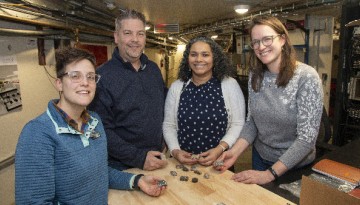
The project, dubbed AUGER (Accelerating Use of Geologically-driven Engineering & Reclamation), was awarded $739K of funding from NSF’s Convergence Accelerator to support translational research combining x-ray and hyperspectral imaging capabilities at CHESS with remote sensing techniques to link macroscale data with microscale mineral properties to create predictive mining insights.
Cornell scientists have unearthed precise, microscopic clues to where magma is stored in Earth’s mantle, offering scientists – and government officials – a way to gauge volcanic eruption risk.