Cornell has a long-standing commitment to help lead the fight against climate change, and on April 2 it became a founding member of the International Universities Climate Alliance.
To better predict volcanic activity, Cornell geologists have proposed a new system to discern the stages of a volcano’s unrest – as seen from perceptive satellites.
Associate professor Adam Seth Litwin recently received a Fulbright U.S. Scholar Program grant, allowing him to serve as the J. William Fulbright Visiting Professor of Work and Organizational studies at the University of Sydney in Australia.
As the coronavirus pandemic sent the entire world reeling, Cornell’s Southeast Asia Program had to make a last-minute decision regarding its annual graduate student conference, March 13-15.
Giving Day, March 12, brought generous Cornell community members together from around the world to raise more than $7 million – including emergency funds in response to the coronavirus epidemic.
A Global Climate Change Science and Policy course supported by an Engaged Curriculum Grant is helping Cornell students and researchers lead efforts in Armenia to mobilize action related to agriculture.
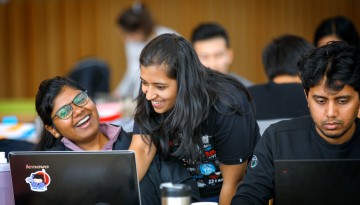
Students in fields ranging from computer science and engineering to business, agriculture and animal science convened at the second Digital Agriculture Hackathon, Feb. 28-March 1, with a shared purpose: to combine their disparate skills to brainstorm ways to make the world a better place.