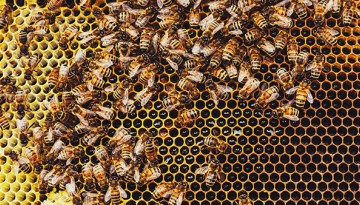
The founders of Combplex, a startup run by two Cornell doctoral students, presented their bee colony monitoring technology in Washington, D.C., Nov. 14.
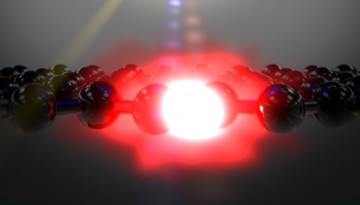
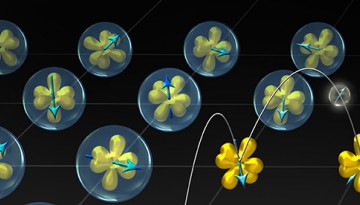
A group led by physics professor Paul McEuen reports clear visualization of excitons in bilayer graphene, the unique properties of which make the material of potential interest in the development of optoelectronic devices.
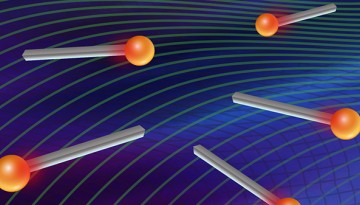
Curiosity regarding the Japanese tree frog led mathematician Steve Strogatz and a student to the study of systems that align both in time and space - which they've dubbed 'swarmalators.'
A group led by assistant professor Justin Wilson has developed a binding molecule that could improve targeted alpha-particle therapy - injected radiation treatment - for prostate cancer patients.
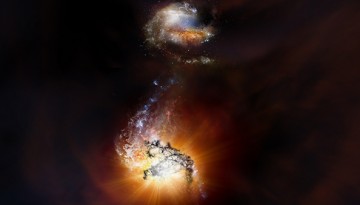
A pair of massive, hyper-luminous galaxies, discovered by a Cornell professor and a graduate student, are merging in front of astronomer’s eyes for the first time and revealing secrets of cosmic creation.
Four teams of engineering faculty and students each received up to $20,000 from the college to advance their laboratory research toward functioning prototypes.
A group led by physics professor Kyle Shen proposes an answer to a decades-old question regarding a class of materials known as "mixed valence" compounds, which display exotic physical properties.
A group led by chemistry professor Peng Chen reports the first quantitative visualization of enhanced catalysis activity at the metal-metal interface of a single-molecule bimetallic nanocatalyst.
As Puerto Rico continues to recover from Hurricane Maria, Cornell is offering a free semester of study – including tuition, room and board – in spring 2018 for up to 58 students from Universidad de Puerto Rico.