Four doctoral students studying fields in the College of Arts & Sciences are the inaugural recipients of the Zhu Family Graduate Fellowships in the Humanities.
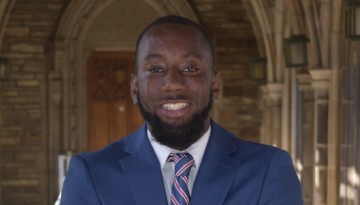
Mar’Quon Frederick will spend the summers of 2022 and 2023 in Washington, D.C., participating in internships, seminars on government and economics, and leadership and professional development workshops.
A Cornell collaboration crossing medicine, law, technology and communication is aiming to encourage the use of health care benefits by refugees in the U.S. – who often suffer poor health but are using these entitlements less than they have in the past.
After honing her wine skills through eCornell classes, NASA engineer Rada Griffin launched Anissa Wakefield Wines, becoming the first certified Black woman winemaker in Alabama.
A multimillion-dollar grant from LinkedIn to the Cornell Ann S. Bowers College of Computing and Information Science has launched a long-term, strategic partnership to support research in artificial intelligence, and to bolster diversity initiatives within the college.
A select group of student entrepreneurs are chosen from W.E. Cornell's fall cohort to participate in its spring cohort where they conduct customer discovery and hone their business models.
Christina Ochoa, who advocates for incarcerated people serving life sentences in New York state through the Cornell University Parole Initiative, earned the Newman Civic Fellowship for her dedication to transforming systemic injustice in prisons and parole policies.
A summit hosted at Cornell Tech on Feb. 28 brought together more than 50 principals, guidance counselors, students and leaders from community-based organizations to discuss how to grow Cornell’s Bridge Scholars program from a successful pilot initiative into a nation-wide collaborative.