Fungi could transform leftovers into lifelines

Mycelium, the vegetative, root-like network of fungi, has the power to transform food waste into new, life-sustaining food.

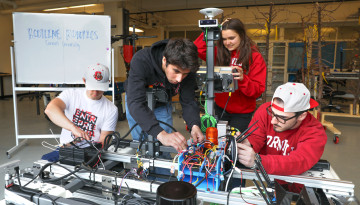
EdemaFlex: soft-robotic glove for swelling relief

EdemaFlex, a new glove with more than three dozen actuators across all five fingers and the palm, developed by Cornell researchers, aims to reduce swelling for people suffering from edema.

Literary critic Biodun Jeyifo dies at 80

Biodun “BJ” Jeyifo, a leading literary critic and cultural theorist known for his analysis of modernity and its attendant social and cultural crises, died Feb. 11 in Lagos, Nigeria. He was 80.

Hackathon winners combat ear infections, parasites and animal overpopulation

Products to fight ear infections in dogs, a parasite in cattle and animal population control challenges won top honors at the Feb. 20-22 Animal Health Hackathon at the College of Veterinary Medicine.

Around Cornell

Carnegie classification recognizes Cornell’s community engagement

Cornell has earned the Carnegie Community Engagement Classification, a national designation recognizing universities with sustained, mutually beneficial community partnerships.

New strategies aim at HIV’s last strongholds

A new study has overcome a long-standing challenge: how to isolate and study elusive HIV-infected cells called authentic reservoir clones that evade the immune system, making the disease difficult to cure.

Scientists identify regenerative checkpoint that limits muscle repair

The finding could lead to improved treatment for conditions like muscular dystrophy and severe injury.

Abruña honored for chemistry in the public interest

The Gustavus John Esseln Award for Chemistry in the Public Interest from the Northeastern Section of the American Chemical Society honors outstanding achievement in scientific and technical work that contributes to public well-being.

Around Cornell

Triggering self-combustion in fat cells for weight loss

Ordinary fat cells in obese animals can be induced to burn energy stores, generating substantial heat, according to a preclinical study by Weill Cornell Medicine investigators.