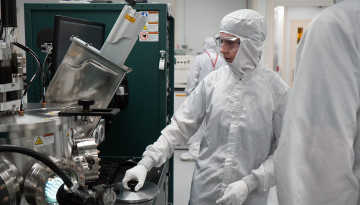
A $9.5 million investment in the Cornell NanoScale Science and Technology Facility from Duffield Engineering will position the facility for its next era of leadership in semiconductor research, education and workforce training.
An exhibit of brilliantly colored Ukrainian Easter eggs, or pysanky, is one of several new initiatives Cornell’s Ukrainian Program is undertaking to bring the culture, language and history of Ukraine to the Cornell community.
James Garbarino, MAT ’70, Ph.D. ’73, professor emeritus of human development and a renowned expert on childhood trauma, died March 7 in Ithaca. He was 78.
An autonomous artificial intelligence platform developed at Cornell streamlines materials research by quickly identifying key features in a microscopy image.
The Dallas Morse Coors Concert Series at Cornell University closes its 2025-26 season with a performance from Flamenco Vivo Carlota Santana on April 11 at 7:30 p.m. at Bailey Hall.
More than 300 Cornell employees and community members attended the seventh annual Inclusive Excellence Summit on March 24, gathering virtually from across the nation for a day of connection and reflection.