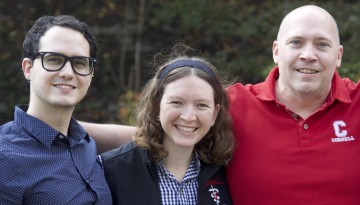
Bhargav Sanketi won the Council of Graduate Schools Three Minute Thesis (3MT) competition. 3MT challenges graduate students to present their thesis research compellingly to general audiences in just three minutes.
Twenty-six students with businesses ranging from drinking water treatment to alternative medicine to kitchen robots, received fellowships to work on their businesses this summer.
On the occasion of the Department of Architecture's sesquicentennial, a transdisciplinary slate of leading scholars and designers — from indigenous geographers and storytellers, to architecture and landscape historians and critics, and leaders of contemporary architecture practice and pedagogy — will join Breaking Ground(s) a series of conversations that intersect at the notion of ground. Or, grounds.
Morten H. Christiansen, William R. Kenan, Jr. Professor of Psychology in the College of Arts and Sciences, has been elected a foreign member of the Royal Danish Academy of Sciences and Letters.
New York growers will get a sustainable boost this planting season from the new Soil Health and Climate Resiliency Act – backed up by Cornell research – and signed into law by Gov. Kathy Hochul.
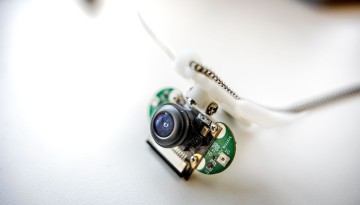
Cheng Zhang, assistant professor of information science, and doctoral student Ruidong Zhang have developed a silent-speech recognition device, SpeeChin, that can identify silent commands using images of skin deformation in the neck and face.
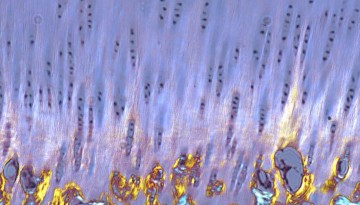
Four Cornell faculty members from three different colleges received the 2022 Kappa Delta Ann Doner Vaughn Award for their collaborative research on the mechanics and composition of articular cartilage and its relevance to disease.
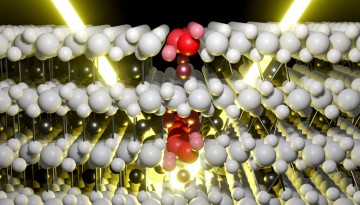
A new X-ray technique developed by Cornell engineers has revealed the cause of a long-identified flaw in sodium-ion batteries; a discovery that could prove to be a major step toward making sodium-ion as ubiquitous as lithium-ion.