Students in the College of Veterinary Medicine provided spay-neuter and wellness services for a total of 50 cats from underserved communities in the greater Ithaca area to mark World Spay Day Feb. 12
The tools of AI and machine learning will soon be at the fingertips of the College of Veterinary Medicine’s faculty, staff and students to mine more than 1.4 million clinical cases and 14.2 million diagnostic tests to assist in clinical research.
Cornell Venture Capital hosted Liza Landsman ’90, and Jillian Williams to inspire the next generation of investors and entrepreneurs and shed light on how women and minorities can break into the venture capital industry.
A Cornell-led collaboration used electrochemistry to stitch together simple carbon molecules and form complex compounds, eliminating the need for precious metals or other catalysts to promote the chemical reaction.
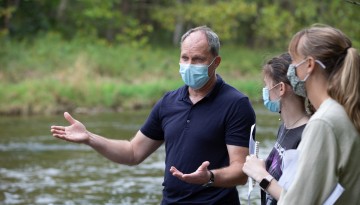
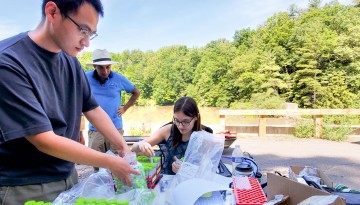
Instructors Marc Goebel and Kira Treibergs work to ensure that students in Introductory Field Biology (NTRES 2100) have a collaborative learning experience. Student teams build confidence through collaborating on field research and learning to read the landscape.
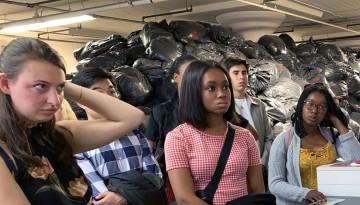
A new course on global textile and apparel sustainability attracts students from across the university and immerses students in the real-life, contemporary challenges of sustainability in the fashion industry. The course was structured to address the connection of fashion to the 17 sustainability goals outlined by the United Nations Department of Economic and Social Affairs.
A recent gift from Cornell’s Chi Chapter of Delta Gamma will create an annual speaker series for the Cornell Women’s Resource Center, and provide funding for the series in perpetuity.