A 2021 Outstanding Achievement Award from the University of Illinois Department of Mathematics recognizes advances in the field by Michael Stillman, professor of mathematics.
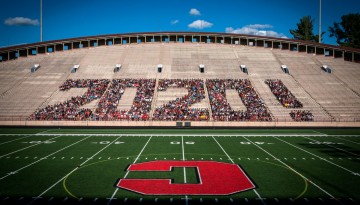
More than a year after they left campus and moved on to the next stage of their lives, the Class of 2020 came together once again, in celebration, with a virtual Commencement June 13.
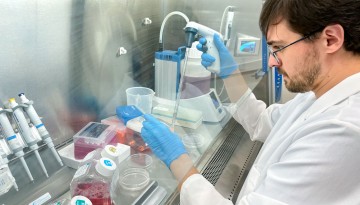
Julius Judd, a fourth-year doctoral student in the graduate field of molecular biology and genetics, has been selected for the 2021 Harry and Samuel Mann Outstanding Graduate Student Award.
Cornell researchers have discovered a rare “pseudogap” phenomenon that helps explain how the superconducting transition temperature can be greatly boosted in a single monolayer of iron selenide, and how it might be applied to other superconducting materials.
Researchers from Cornell’s School of Applied and Engineering Physics and Samsung’s Advanced Institute of Technology have created a first-of-its-kind metalens – a metamaterial lens – that can be focused using voltage instead of mechanically moving its components.
Gemma Rodrigues will direct the education program at the Johnson Museum to support critical inquiry and appreciation of global arts and cultures for Cornell classes, K-12 teachers and schools, community groups, and the public.
The major gift from the Brooks family, whose Cornell roots span three generations, provides an early boost to help the university’s newest school achieve world-class excellence.