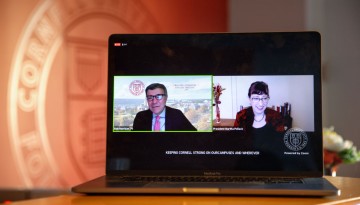
In her fourth State of the University Address, Cornell President Martha E. Pollack announced that two residence halls will be named for U.S. Supreme Court Justice Ruth Bader Ginsburg ’54 and Nobel Prize-winning author Toni Morrison, M.A. ’55.
Baobao Zhang’s three-year Klarman Postdoctoral Fellowship in the College of Arts and Sciences is an opportunity to research technology policy, particularly on the governance of emerging technologies such as AI.
The Cornell Defender Program virtually teamed undergraduates and law students with trial attorneys to support indigent defense in Tompkins County and a more diverse pipeline of students interested in law careers.
Cornell’s Adult University is hosting free and pay-to-view live online seminars open to the public this fall, beginning with “The 2020 Presidential Election – an Online Seminar.”
Three New York state companies have been chosen to participate in the Cornell Center for Materials Research JumpStart Program, through which they will collaborate with faculty members to develop and improve their products.
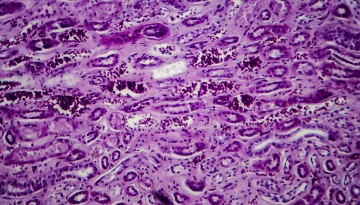
Researchers led by Hening Lin have found a new way to potentially treat inflammatory bowel disease, as well as other autoimmune disorders, by targeting a mechanism that regulates the signaling pathway that enables inflammation to occur.
Professor Jonathan Boyarin studied at Mesiytha Tifereth Jerusalem, New York’s oldest institution of rabbinic learning. His new book describes his experiences in “Yeshiva Days: Learning on the Lower East Side.”
A $2 million grant from the National Science Foundation will fund research, led by Nicholas Abbott from the Smith School of Chemical and Biomolecular Engineering, into “microcleaners” for waterways.