The Cornell United Way Campaign – the campus drive to support the United Way of Tompkins County by raising funds for local community members in need – launches Oct. 15 and runs through December.
Human tracks at White Sands National Park record more than 1.5 kilometers of a journey and form the longest Late Pleistocene-age double human trackway in the world.
Isabel Wilkerson, author of “The Warmth of Other Suns” and “Caste,” will deliver the Cornell Center for Social Sciences’ annual Distinguished Lecture in the Social Sciences at 6:30 p.m. Oct. 21.
Engineering professor Max Zhang has been awarded a NYSERDA grant to determine efficient solar farm array configurations so the state can avoid land-use conflicts or spoiling precious agricultural space.
Thousands of alumni, parents, students and friends from around the globe participated in StayHomecoming week events Oct. 6-10, an entirely online event for the first time.
Charles H. Moore ’51, an Olympic gold medalist who went on to set Cornell athletics on firm footing as athletic director in the 1990s, died Oct. 8 at his home in Pennsylvania. He was 91.
An intercampus research team has been awarded a five-year, $3.65 million grant from the National Institutes of Health to develop a quick, inexpensive method for accurately diagnosing urinary tract infections in kidney transplant patients.
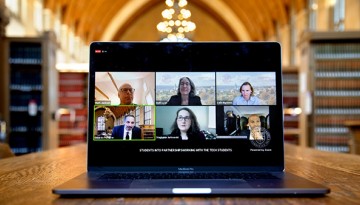
The Oct. 9 StayHomecoming keynote panel featured the work of four Cornell Law School clinics, which offer students real-world experience while helping people who otherwise may not be able to afford legal services.
The Carl Sagan Institute is getting a boost from an unexpected source: Fiat Chrysler Automotive. The company’s ad for its new Wrangler 4XE plug-in hybrid features the late astronomer Carl Sagan’s famous “Pale Blue Dot” monologue and images.